
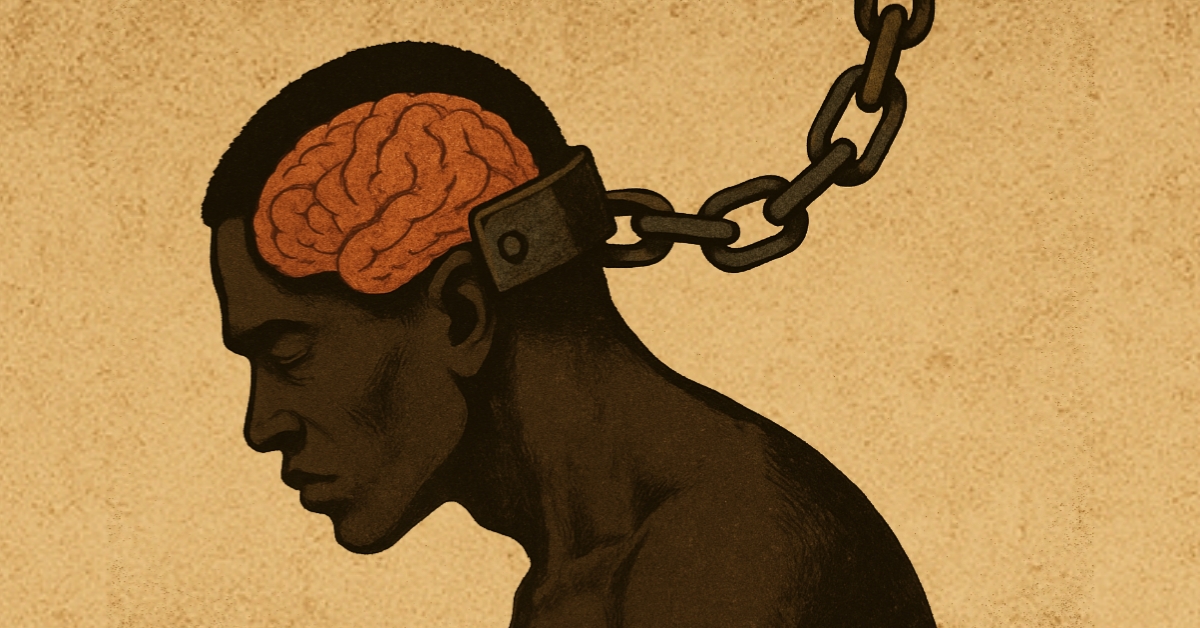
Discover how nations fall into mental slavery long before political conquest. This in-depth reflection explores the psychological and spiritual roots of enslavement through both Islamic philosophy and modern thought. It reveals how self-doubt, cultural imitation, and loss of divine purpose weaken civilizations from within — and how faith, reason, and self-awareness can rebuild true intellectual freedom. A must-read for anyone seeking to decolonize the Muslim mind and revive authentic confidence.
The Invisible Chains of the Mind
Empires may fall, borders may change, and rulers may come and go — but the most enduring form of slavery is the one that settles in the mind. When people lose faith in their own worth, their intellect, and their spiritual mission, external domination becomes merely a consequence of inner defeat. This condition, often called mental slavery or intellectual colonization, is not new. It has haunted civilizations from ancient empires to the modern Muslim world.
In the words of the Qur’an:
“Indeed, Allah will not change the condition of a people until they change what is within themselves.” (13:11)
This verse captures the essence of mental liberation — that the true battlefield of freedom lies with1. in.
1. What Is Mental Slavery?
Mental slavery is the condition in which a person or nation subconsciously accepts the superiority of others — their values, systems, and judgments — while doubting its own. It is a psychological submission that outlives physical conquest.
In colonial times, nations were enslaved through force. Today, many remain enslaved through ideas. Their languages, tastes, fashions, and even ideals of “progress” are defined by others. The enslaved mind begins to imitate rather than create, to consume rather than produce, to admire rather than question.
As Malcolm X once said, “The most dangerous thing the oppressor can do is to give you a low opinion of yourself.”
2. The Islamic View: True Freedom Lies in Submission to God
In Islam, freedom begins not with rebellion against rulers but with liberation from false gods — including the idols of ego, wealth, and worldly power. When the Qur’an invites humans to ‘worship none but Allah’, it simultaneously invites them to reject servitude to anything else.
Historically, the Prophet Muhammad ﷺ freed his followers from the shackles of tribal arrogance, social hierarchies, and blind imitation. The early Muslims gained not just political strength but intellectual and moral independence — they saw themselves as vicegerents (khulafa’) of God on earth, responsible for justice, learning, and truth.
But over time, many Muslim societies lost this inner freedom. They began to glorify rulers, scholars, and foreign cultures instead of divine principles. The spiritual disease of imitation (taqlīd a‘mā) replaced critical thought and ijtihad (independent reasoning).
3. Psychological Roots: How the Mind Becomes Colonized
From a psychological point of view, mental slavery operates through three interlocking mechanisms:
a. Inferiority Complex
When a nation repeatedly faces defeat — military, economic, or intellectual — it develops a subconscious belief in its own inadequacy. This belief manifests as self-doubt, the need for external validation, and blind admiration of others’ systems.
In education, this appears when students think Western knowledge is superior to their own tradition. In culture, when foreign lifestyles are considered “modern,” while one’s own is “backward.”
b. Learned Helplessness
Psychologists describe this as a condition where individuals stop trying to change their circumstances because they’ve been conditioned to believe their efforts are useless. In colonized nations, this takes the form of “we can’t progress” or “we have always been behind.”
Such thinking slowly kills creativity, entrepreneurship, and courage — replacing them with dependence.
c. Cultural Conditioning
The media, education systems, and global entertainment subtly train people to adopt alien worldviews. This is not always malicious — it’s the result of global power dynamics. But when a society consumes information uncritically, it internalizes others’ priorities. The colonized mind starts measuring success through someone else’s lens.
4. Historical Perspective: From Political Conquest to Intellectual Dependency
The colonial era physically subjugated much of the Muslim world. But even after political independence, the intellectual legacy of colonization endured.
Educational systems in many Muslim-majority countries still produce graduates who know Western philosophy but are alien to their own intellectual heritage.
This is what the Algerian thinker Malek Bennabi called “colonisabilité” — a state of being mentally ready to be colonized. In his view, material defeat is only possible after moral and intellectual decay. Once a nation stops believing in its own civilizational mission, it opens itself to external domination.
Similarly, Iqbal argued that self-realization (khudi) is the foundation of all power. Without it, even material progress is hollow.
“The ultimate aim of the ego is not to see something, but to be something.”
5. Signs of a Mentally Enslaved Society
A society suffering from mental slavery exhibits certain recognizable traits:
- Imitation over innovation – preferring to copy others rather than build from its own values.
- Dependency on validation – seeking approval from Western or foreign authorities.
- Loss of historical confidence – ignorance of its own intellectual heritage.
- Passive religiosity – religion becomes ritualistic, detached from action or thought.
- Moral confusion – inability to distinguish between genuine progress and cultural erosion.
These are not external problems; they are internal diseases of the collective psyche.
6. The Dual Nature of Slavery: Political and Psychological
Political slavery is the visible outcome; psychological slavery is its invisible cause.
A nation can regain its territory but remain enslaved in thought if it continues to borrow its ideals, economic systems, and moral compass from its former masters.
The Qur’an repeatedly links the downfall of nations to inner corruption rather than external power:
“That is because Allah would not change a favor which He had bestowed upon a people until they change what is within themselves.” (8:53)
Thus, mental freedom — the freedom to think, believe, and act independently in light of divine truth — becomes the first step toward collective revival.
7. The Path to Mental Liberation
a. Reconnecting with Revelation
Islamic revelation liberates by reconnecting man to his Creator. It restores self-worth through purpose: every human is a trustee of God’s will on earth. When individuals internalize this truth, they cease to bow before worldly powers.
b. Reviving Critical Thought
True ijtihad is not limited to legal rulings; it’s a mindset — the courage to think independently while remaining rooted in moral truth. Muslim youth must learn to read both the Qur’an and the world with open eyes, synthesizing faith and reason.
c. Educational Reform
Education should cultivate self-awareness before skill. A system that teaches technology without ethics or history without philosophy merely produces efficient slaves.
Integrating Islamic thought, global sciences, and philosophy can rebuild intellectual confidence.
d. Cultural Self-Confidence
Reclaiming our art, literature, and language is crucial. The colonized mind often despises its mother tongue, thinking fluency in English equals intelligence. But language carries worldview. To lose your language is to lose your lens of reality.
e. Economic and Political Integrity
Mental slavery thrives on dependence — financial, cultural, and political. Building economic independence and ethical governance reinforces dignity and trust in one’s own systems.
8. Lessons from the Past: From Decline to Revival
History proves that mental enslavement is reversible. The same civilization that once led humanity in science, ethics, and governance did so not by imitation but by belief in divine guidance and the value of knowledge.
The Andalusian renaissance, the Abbasid translation movement, and Ottoman reforms all began with a return to intellectual confidence. When Muslims believed their values could shape the world, they did.
But every time they doubted themselves, others defined their destiny.
9. The Modern Challenge: Digital Colonization
Today’s colonization is not territorial; it’s informational.
Social media algorithms, entertainment industries, and global consumerism shape desires and identities more powerfully than armies ever could. The new imperialism operates through persuasion, not force.
To resist it, individuals must practice digital consciousness — filtering what they consume, questioning narratives, and producing alternative knowledge rooted in faith and reason.
10. Toward a Free Mind and a Revived Ummah
Mental slavery ends when thought and faith reunite. The Muslim mind must rediscover its dual heritage — the rational vigor of philosophy and the spiritual depth of revelation.
Freedom, in Islam, is not doing whatever one wants, but being free from everything that distracts from truth. As the poet Iqbal said:
“The man who knows himself is free even in chains.”
When individuals break the inner chains of imitation, nations will naturally break the outer chains of oppression.
Conclusion: Change Begins Within
The decline of nations begins in thought and spirit long before it manifests in politics or economics. Mental slavery is not an external imposition but an internal surrender. True liberation — personal or collective — begins with the awakening of consciousness, the rediscovery of divine purpose, and the courage to think freely.
Every generation must ask itself: Are we shaping our world, or merely reacting to someone else’s?
When minds awaken, civilizations rise. When hearts submit only to Allah, no power on earth can enslave them.
